11 May 2026
01:20am – Llanishen High School
Forty students. Five days. Suitcases, snoods and snacks.
By the time we met outside the school gates, most of our Year 10-13s were running almost entirely on excitement.
A few hours later, we landed in Iceland with a -5 wind chill and immediately understood… We weren’t in Cardiff anymore.
No time to ease ourselves in either. Straight off the plane and into landscapes that, quite honestly, looked unfinished. Lava fields. Steam rising from the ground. Dark coastlines shaped by volcanic eruptions that still happen regularly today. Sir David Attenborough (happy birthday Sir) once said “I wish the world was twice as big – and half of it was still unexplored.” With what lay ahead of us, we all felt our world had just got a whole lot bigger.
Iceland sits directly between the North American and Eurasian tectonic plates. The island itself is still slowly drifting apart by around two centimetres each year.
You can actually see it happening.
09:43am – A Bridge Between Continents
The further we trekked, the more Iceland changed around us.
Hot springs appeared in the middle of nowhere. Moss-covered lava fields stretched for miles. The coastline shifted between black rock and crashing Atlantic waves. Even the light looked different, somehow longer.
Standing near boiling geothermal pools while the cold air rolled in from the coast, it was difficult to disagree with Sir David’s earlier observations.
Day Two – The Golden Circle
The Secret Lagoon was top of our list.
Built beside natural hot springs over 100 years ago, it is one of Iceland’s oldest swimming spots and sits in a cloud of steam all day long. And of course, the cold plunge challenge started almost immediately. But these waters were a little less familiar than Lisvane & Llanishen Reservoir.
Some students lasted seconds.
Some were determined to set records.
Dried off and warmed up, we headed towards Gullfoss Waterfall. The name translates to “Golden Falls”. The waterfall drops in two stages into the canyon of the Hvítá River, carved by glacial floods thousands of years ago.
At 105 feet high, the sound reached us before the water did. To give you an idea of the audio, that’s an average water flow of 109 cubic metres of water per second, around 3,849 cubic feet. That’s loud.
How do you follow up one of Europe’s most powerful waterfalls? With Iceland’s famous Strokkur geyser. Every few minutes, the ground bubbled and then exploded into the air. Cameras at the ready. Timing was everything, for the lucky few.
Next stop; ice cream obviously. A local dairy farm, overlooking a volcanic landscape. Pure surrealism.
We ended the day, with the then-upcoming Senedd Elections very much on our mind, at one of the earliest parliaments, founded in 930 AD. Politics aside, the views secured our vote.
Day Three – Fire & Ice
Iceland is a wonder.
The LAVA Centre explored the volcanic history of the island, including eruptions that have disrupted roads, flights and entire communities within recent years. Around 130 volcanoes exist across Iceland, and roughly 30 are currently active. Real firepower.
Then the ice and Sólheimajökull Glacier.
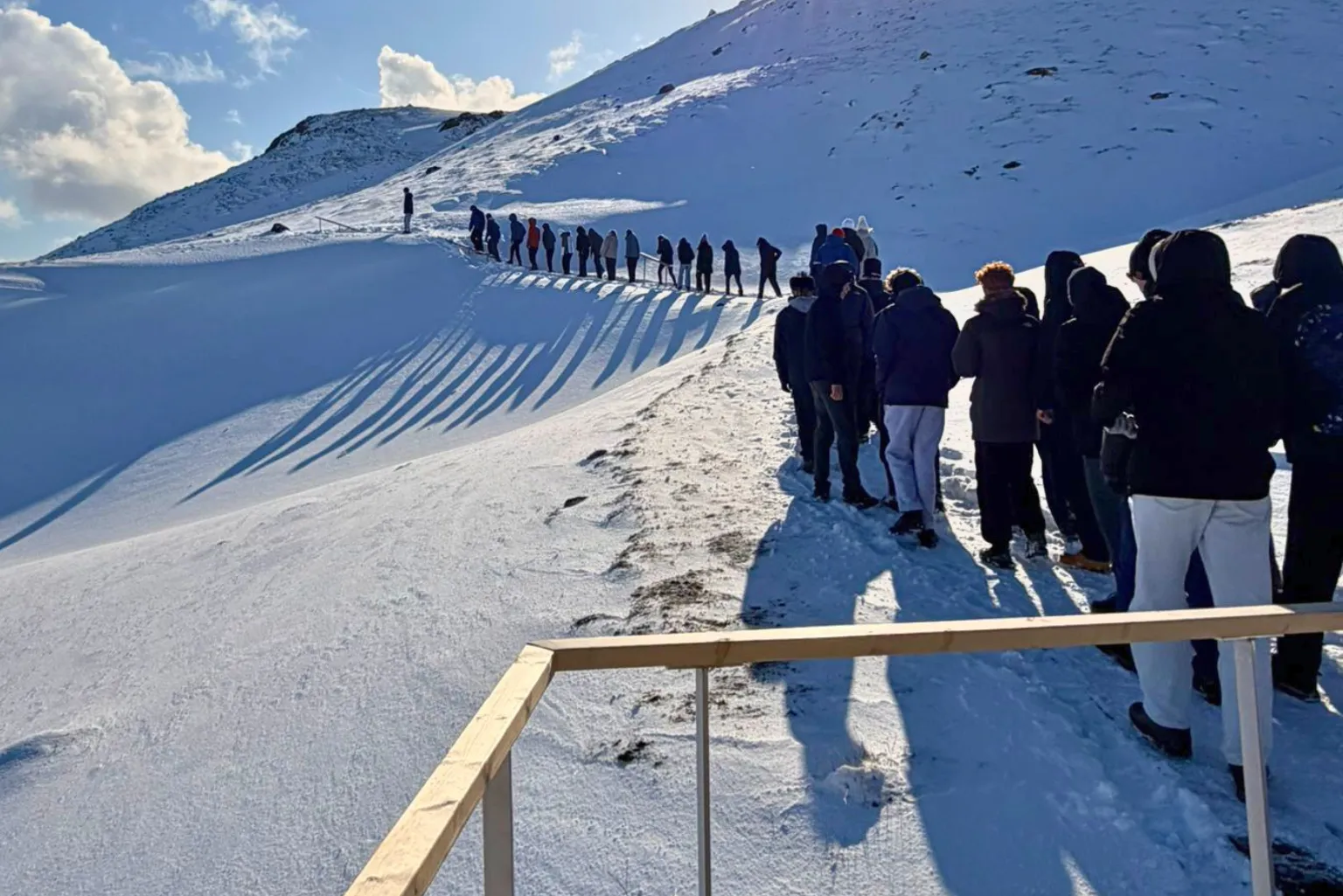
We have pictures. They won’t help. You can’t judge the distance. Everything feels enormous. The ice looked blue in places and grey in others. Meltwater cut through the glacier in narrow streams and the surrounding black volcanic ash made all that look even sharper.
Glaciers cover around 11% of Iceland’s land surface, although many have retreated significantly over the last century because of rising global temperatures. Sir David Attenborough warns, in his Netflix documentary, Our Planet, “Glaciers have always released ice into the ocean, but now this is happening nearly twice as fast as it did ten years ago”. Standing beside one makes those conversations a little more real.
It was a point in the trip where we all took a quiet moment.
No superhuman challenge. No Instagram moment. Just taking it all in.
Final Full Day – Braced for Blizzards
Our luck ran out. Without much warning the weather changed.
One moment: breakfast. Next: blizzard.
Roads closed temporarily, snow swept across the hotel windows and plans for the morning were postponed. Icelandic weather has a habit of doing what it wants, which is probably why locals often say: “If you don’t like the weather, wait five minutes”.
So we adapted.
Less bracing than the Secret Lagoon, we fully utilised the hotel swimming pool.
Once the roads reopened, we travelled to the world’s northernmost capital city, Reykjavik. Bright buildings, street art, bookshops, expensive souvenirs and the ongoing quest of all intrepid explorers… finding the best burger.
Keflavík Airport – Homecoming
Somewhere between the early starts, snowball fights, black sand beaches and dramatic weather changes, Iceland went from being landscapes in a documentary to memories for life.
We couldn’t cover it all. Moments still to mention. Waterfalls hidden beside roads. Steam drifting across hillsides. The logistics of packing more than we came with.
The students; they did us proud. Enthusiastic, punctual and bringing the kind of energy you need to keep warm in -5 wind chill. As we celebrate Sir David Attenborough’s 100th birthday, this feels like the right way to wrap up our Easter adventure to Iceland.
We really have discovered, “There is so much more out there than what connects to us”. Wise words, from a great man.